Common Misconceptions About Fermented Foods UK
As an Amazon Associate I earn from qualifying purchases. This page contains affiliate links — if you buy through them, I earn a small commission at no extra cost to you.
Let’s be honest, the word ‘fermented’ often conjures up images of bubbling jars on Instagram, quickly followed by the thought, “What if I get botulism?” That fear is real, but it’s largely misplaced when it comes to fermenting vegetables at home. You don’t need a lab coat or a chemistry degree; just a few simple rules will keep you safe in your British kitchen. I’ll strip away the myths holding you back and show you how straightforward it really is. If you’re new to all this, you can find out more about me here.
Myth 1: “Fermented Foods Are the Same as Probiotics”
Probiotics, in the strict sense, are live bacteria you take as a supplement – usually a single strain that has been clinically tested. Fermented foods, on the other hand, are whole foods that host a whole community of microbes and the fibre that feeds them.
- Food – a mix of lactobacilli, yeasts and other bacteria, plus prebiotic fibre from the vegetables.
- Supplement – one or two well‑characterised strains, often encapsulated and marketed for a specific health claim.
The honest answer is that while a jar of kimchi does contain “probiotic” bacteria, it isn’t a direct replacement for a supplement that guarantees a certain CFU count of Lactobacillus rhamnosus GG, for example. The MDPI review notes that the diversity in fermented foods can be beneficial, but the strains aren’t always the ones proven in clinical trials.
In the UK, probiotic supplements are regulated by the MHRA, meaning manufacturers must back any health claim with evidence. Food, however, falls under general food law – you can’t legally claim “cures IBS” on a jar of sauerkraut. For more on this, the Food Standards Agency (FSA) has clear guidance on nutrition and health claims for food products. So, if you’re after a specific therapeutic effect, a supplement might be worth a chat with your GP; for flavour, texture and a happy gut, a well‑made ferment does the job nicely.
Myth 2: “You Need Expensive Equipment to Start”
The first time I tried a “professional” set‑up – a stainless‑steel fermenter, a temperature‑controlled chamber and a fancy airlock – I ended up with a half‑filled jar that looked more like a science experiment than dinner. The truth is, a simple glass jar does the trick.
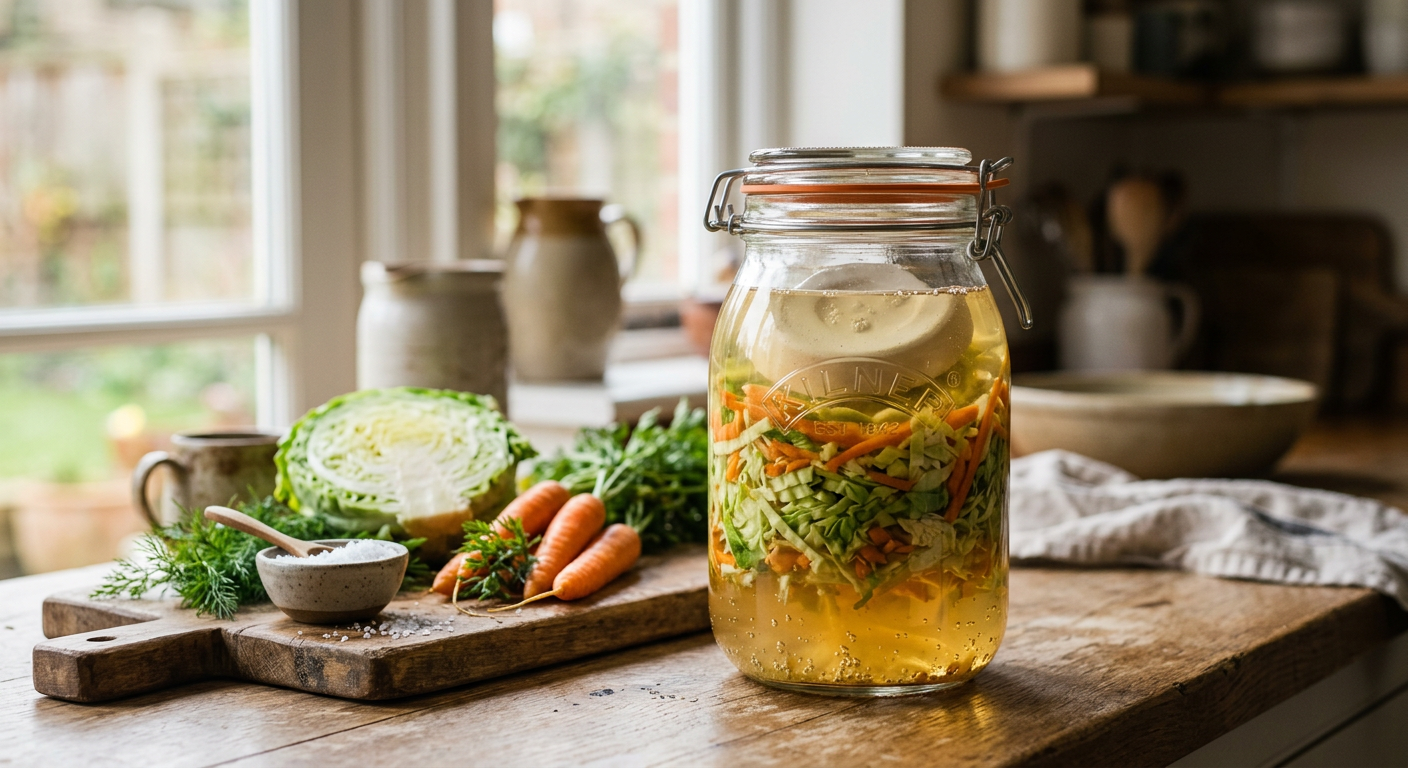
A Kilner Fermentation Jar Set (paid link) (roughly £15–£25 for the basic three‑jar kit) is more than enough for a beginner. The jars are thick, BPA‑free glass, which means no unwanted flavours leach in, and the clear sides let you watch the bubbles without opening the lid. The included ceramic weights keep the vegetables under the brine – that’s the golden rule, because exposure to air invites mould.
I did learn the hard way that cheap plastic lids can warp in the fridge, letting air in and spoiling the batch. The Kilner lids have a silicone seal that stays flexible even in a cold British kitchen, so you avoid that faff. The only extra you might consider is a small fermentation weight set (around £8) if you’re making larger batches.
Is Fermentation Dangerous and Does it Cause Botulism?
No, fermentation is not dangerous, and botulism is virtually unheard of in properly salted, refrigerated vegetable ferments. Clostridium botulinum thrives in low‑acid, anaerobic environments that are warm (above 30 °C) and have little salt. A proper vegetable ferment, however, is salty (at least 2 % salt by weight) and kept in the fridge once the bubbling slows.
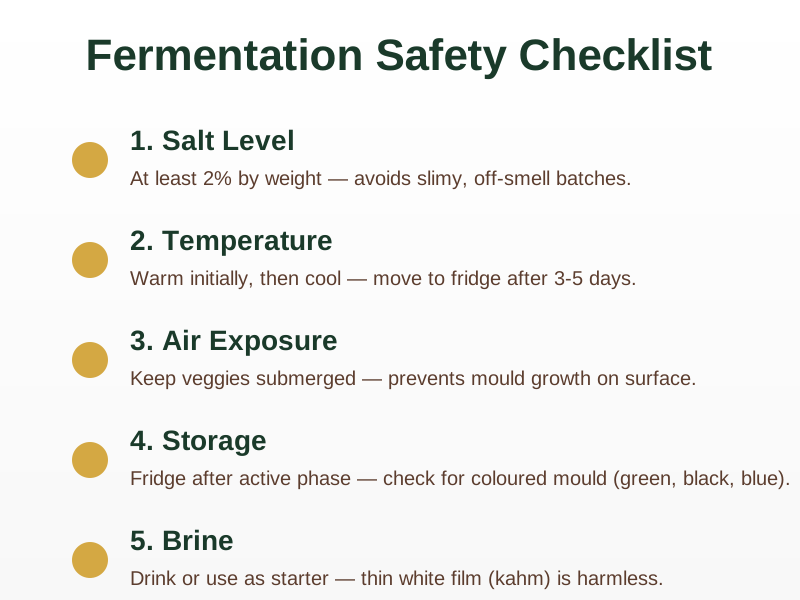
The NHS states that the risk of botulism in a salted, refrigerated ferment is “extremely low”. The key safety checklist is:
- Salt – at least 2 % (roughly 20 g of sea salt per litre of water). I once tried a “low‑salt” sauerkraut and ended up with a slimy, off‑smell batch that had to be bin‑ned.
- Refrigeration – after the initial 3‑5 days at room temperature, move the jar to a fridge (15‑20 °C typical UK kitchen, but cooler is better). This slows any unwanted microbes.
- Mould watch – a thin white film (kahm yeast) is harmless; green, black or blue mould means toss the whole jar.
If you keep these three points in mind, the “danger” myth collapses. The safety guide I put together for beginners breaks it down step‑by‑step, and you can find the full version here:
Myth 4: “You Can Ferment Anything with Just Vinegar”
Vinegar pickling and fermentation are often lumped together, but they’re fundamentally different. Vinegar is an acid that kills bacteria; fermentation is a live process where bacteria eat the sugars in the veg and produce lactic acid themselves.
Because vinegar doesn’t host live cultures, you won’t get the probiotic boost that a kimchi or sauerkraut offers. The BBC’s “Four K’s” – Koji, Kombucha, Kefir and Kimchi – all rely on microbial activity, not just acid. If you’re after a quick, shelf‑stable pickle, vinegar works fine. If you want the funky flavours and the live cultures, you need a true lacto‑ferment.
A common mistake I made early on was to add a splash of white vinegar to a carrot ferment, thinking it would speed things up. Instead, it halted the bacterial activity and left the carrots flat and bland. Stick to salt and water, and let the microbes do the work.
Myth 5: “Mold Means the Whole Batch is Spoiled”
Not all white growth is a sign of doom. Kahm yeast appears as a thin, dry film on the surface – it’s basically a harmless wild yeast that can give a slightly yeasty note. It’s easily skimmed off, and the rest of the ferment is still good.
True mould, however, shows up as coloured fuzz – green, black, blue or pink. That’s a clear warning sign. The rule of thumb I follow is cut it out if it’s just kahm, but bin it if you see coloured mould. Keeping the veggies submerged with weights dramatically reduces the chance of mould, because the air‑exposed surface is where it forms.
The Standalone Safety Answer
Botulism is virtually unheard of in a properly salted, refrigerated vegetable ferment because the salt creates an environment where Clostridium botulinum cannot grow, and refrigeration keeps the temperature below the range where the toxin forms. The essential safety steps are: use at least 2 % sea salt, keep the ferment under the brine, and store it in the fridge after the initial active period. Follow these three rules and you’ll be safe to enjoy your homemade sauerkraut, kimchi or pickled carrots.
Now that you’ve had the myths cleared up, you probably feel ready to try a batch of your own. The next logical step is to make sure you’ve got the right tools and a quick reference checklist. Download the Free Fermentation Starter Checklist – it’s a simple PDF that walks you through salt ratios, weight placement and fridge timing, so you can start without a single faff.
Frequently Asked Questions
Is it safe to eat the liquid (brine) at the bottom of the jar?
Yes, the brine is absolutely safe and often the most live part of the ferment. It’s packed with the beneficial bacteria that did all the hard work, so you can sip it straight or use it as a starter for your next batch.
Do I need to boil the water for fermentation?
No, you don’t need to boil the water for fermentation. Boiling introduces oxygen and can actually encourage unwanted microbes. Just use cool, filtered water – the temperature of your kitchen will be perfectly fine for the bacteria to get going.
How long do fermented foods last in the fridge?
A well‑fermented jar will typically keep for three to six months in the fridge. The flavours will evolve slowly, often becoming softer and more mellow over time, but they remain safe as long as you keep an eye on any mould.
Can I use supermarket cabbage for sauerkraut?
Absolutely, supermarket cabbage works perfectly well for sauerkraut. Organic is often nicer because pesticide residues can sometimes inhibit fermentation, but a regular British cabbage from your local shop will work fine. Just give it a good wash and shred it evenly.
Why is my ferment bubbling?
Bubbling is a fantastic sign! It’s carbon dioxide being released by the lactic acid bacteria as they get to work on the sugars in your vegetables. It means the microbes are active and doing their job – nothing to worry about at all.
Fermentation Safety Checklist
| Safety Step | Key Requirement | What to Watch For |
|---|---|---|
| Salt Level | At least 2% by weight | Avoid slimy, off-smell batches |
| Temperature | Keep warm initially, then cool | Move to fridge after 3-5 days |
| Air Exposure | Keep veggies submerged | Prevent mould growth on surface |
| Storage | Fridge after active phase | Check for coloured mould (green, black, blue) |
| Brine | Drink or use as starter | Thin white film (kahm) is harmless |
| Water | Cool, filtered only | Boiling introduces unwanted microbes |
Where to Go From Here
Fermentation isn’t a mystery science; it’s a straightforward kitchen craft once you know the basics. The myths that keep you from starting – confusing probiotics with supplements, fearing costly equipment, worrying about botulism, mixing up vinegar pickling, and misreading mould – are all debunked. Stick to the salt‑and‑brine rule, keep your veggies under the liquid, and store everything in the fridge once the initial fizz settles.
If you’re ready to turn that Instagram inspiration into a real jar on your own shelf, the next step is simple: Download the Free Fermentation Starter Checklist. It’s a handy cheat‑sheet that makes the whole process spot on, from weighing your salt to burping the jar. You can also browse more tips and recipes on the blog.
Got more questions? Drop me a line – I’m always happy to help a fellow ferment‑enthusiast sort out a tricky batch. You can always get in touch here. Happy fermenting!
Related Guides
For a complete overview, see our Complete Guide to UK Vegetable Fermentation for Beginners.
Sources & Further Reading
- Food Standards Agency (FSA) - Guidance on nutrition and health claims
- NHS - Botulism information
- MDPI - Review on fermented foods and probiotics
As an Amazon Associate I earn from qualifying purchases. The meals and cooking kit linked here are ones I’ve tested or would pack myself.
Note: This information is for general guidance only. Always verify specific health claims and safety protocols with a qualified professional or official source.