Fermentation Equipment UK: What You Actually Need (Under £20)
As an Amazon Associate I earn from qualifying purchases. This page contains affiliate links — if you buy through them, I earn a small commission at no extra cost to you.
Forget the confusing homebrew kits that pop up when you search for “fermentation equipment”. You don’t need a garage full of gear for a simple jar of kimchi or sauerkraut. I’ve been there, wondering if I needed a 20-litre fermenter when all I wanted was a tidy jar of cabbage and a pinch of salt. The truth is, vegetable lacto-fermentation is a different beast entirely, and you can do it safely with just a few basic bits. Let’s strip away the noise and get you sorted with the right gear.
What are the absolute must-have tools for fermenting vegetables?
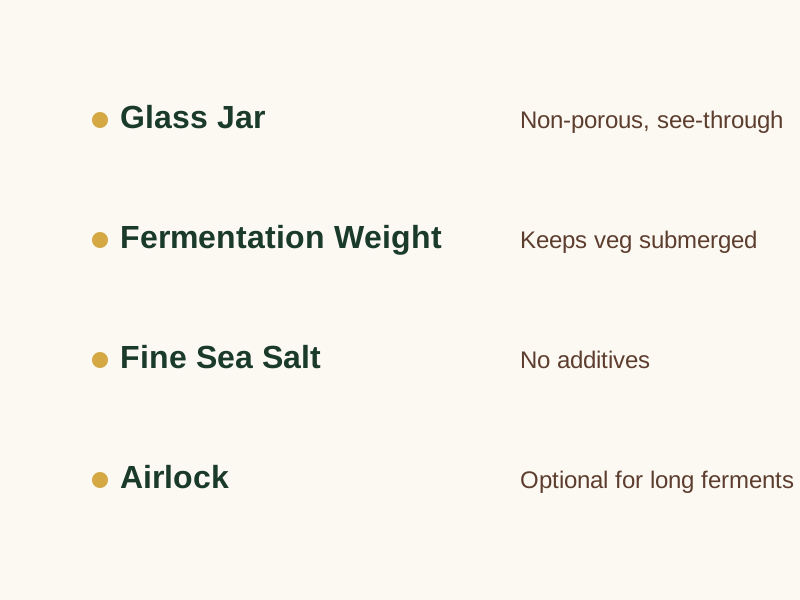
When it comes to keeping your veggies alive and tasty, three things are non‑negotiable:
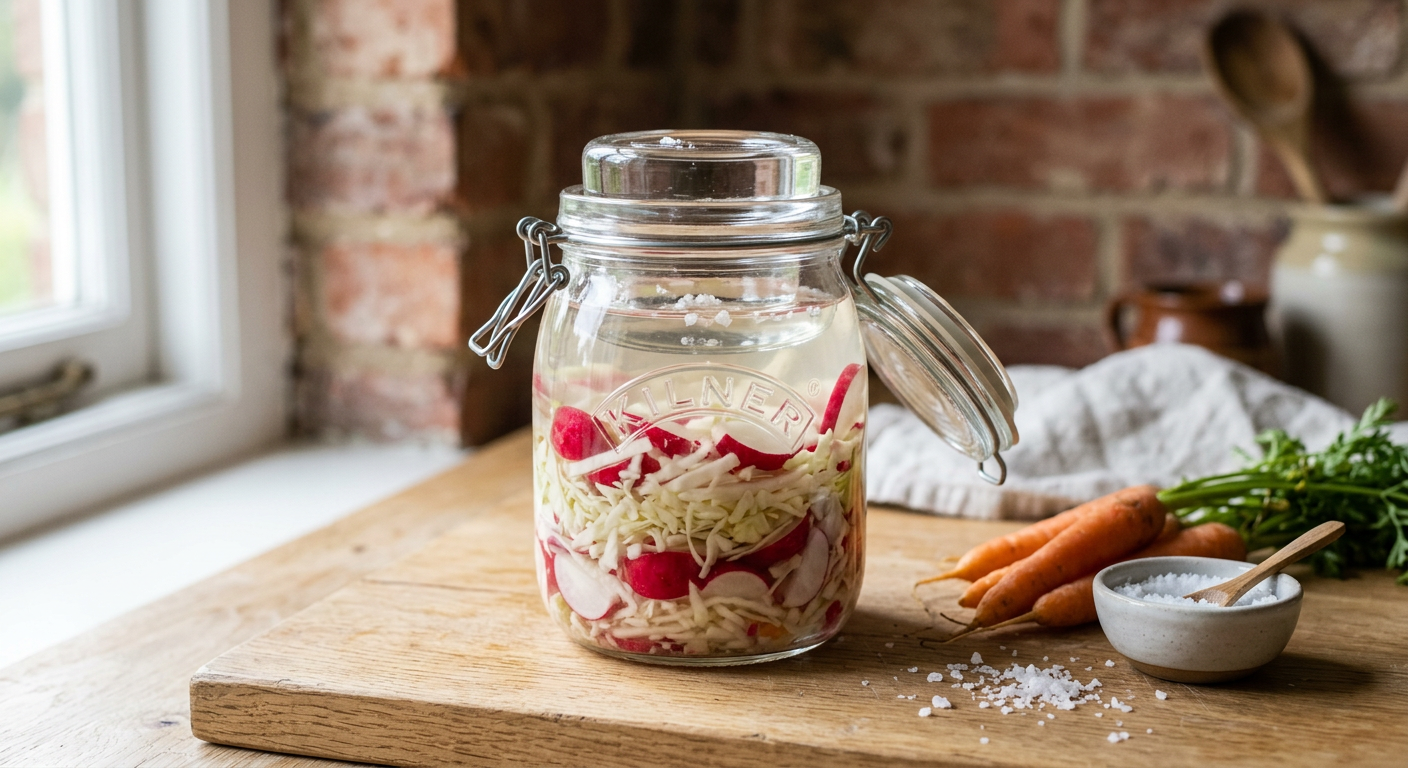
- A glass jar with a good seal – Glass is non‑porous, won’t leach chemicals, and you can see the whole process unfolding. Avoid plastic containers; they can retain odours and, worse, some cheap plastics will leach when the brine gets warm.
- A weight to keep everything under the brine – Mould loves any part of a vegetable that’s exposed to air. A simple stainless‑steel plate, a clean cabbage leaf, or a purpose‑made glass weight does the trick.
- Salt – It creates the protective anaerobic environment and draws water out of the veg, so the brine forms naturally. Use fine sea salt (no anti‑caking agents); iodised table salt will inhibit the lactic cultures.
That’s it – a jar, a weight, and salt. Everything else is optional, especially for your first batch of sauerkraut or pickled carrots.
Simple checklist
- Glass jar (500 ml–1 L) with a two‑piece lid
- Weight (glass pebble, stainless plate, or cabbage leaf)
- Fine sea salt (about 2 % of the veg weight)
If you’ve got those three, you’re already “under the brine”, which is the golden rule for safe fermenting. For more detailed food safety advice on fermented foods, you can always check the Food Standards Agency guidance.
Which fermentation tools are nice to have, but not essential?
Once you’ve mastered the basics, a few extra tools smooth out the rough edges, making the process a bit less of a faff:
Fermentation weights
Glass pebbles marketed as “Masontops Pickle Pebble *(paid link)*s” feel solid, are completely inert, and won’t harbour any lingering flavours. I tried a cheap plastic “silicone weight” once and spent an hour trying to pry it off a stubborn cabbage leaf – not worth the hassle. A set of glass weights (often sold with the Kilner Fermentation Jar) is a small upfront cost that pays off every time you batch.
Airlocks
For short fermentations (3‑7 days) at typical UK kitchen temps (15‑20 °C) you can simply “burp” the jar once a day. An airlock becomes handy if you’re doing a long‑ferment kimchi in a warm summer kitchen, because it lets CO₂ escape without letting oxygen in. The honest answer is, you can skip it for now and add one later if you feel the need.
pH meters
They’re handy for the science‑geek who wants to chart progress, but a well‑salted brine will stay around pH 3.5‑4.0, and a quick taste test tells you when it’s ready. I once bought a digital pH meter, only to discover the probe needed a special cleaning solution I never had on hand – a classic “bodge job”.
These extras aren’t required, but they do turn a bit of a faff into a smooth, repeatable routine.
Where to buy fermentation equipment in the UK (and what to avoid)
Navigating the world of fermentation gear can be tricky, especially when homebrew suppliers dominate search results, but in the UK, you’ll want to stick to kitchenware shops and specific supermarket brands.
Avoid the homebrew aisle
Homebrew shops stock 5‑gal food‑grade buckets, silicone fermenter lids and airlocks designed for alcohol. They’re overkill for a 1‑litre jar of carrots and often come with confusing instructions about specific gravity that have nothing to do with lacto‑fermentation. Stick to kitchen‑ware suppliers or the vegetable‑section of your local supermarket.
Supermarket hacks – where to find proper jars
- Kilner Fermentation Jar Set (paid link) – available at Tesco, Sainsbury’s and most online kitchen stores for roughly £15–£25. Comes with a glass weight and a silicone sealing ring that fits the lid perfectly.
- Le Parfait jars – a bit pricier (around £20 for a 1‑L set) but the hinged clamp gives a tight seal without a separate ring.
- Bormioli Rocco Fido – sold at John Lewis and some independent shops; the swing‑top gives a very secure closure, though you’ll need to buy a separate weight.
- Weck Tulip Jar (paid link) – a stylish option found at Lakeland; the glass clamp is sturdy, but the rubber gasket is single‑use, so budget‑wise it’s a middle‑ground choice.
Material guide – glass vs. plastic
Glass wins every time. It’s easy to sterilise, won’t absorb flavours, and you can see the bubbles building. Plastic buckets can leach, especially when the brine gets warm, and they’re a nightmare to clean without a lingering “ferment” smell.
Sizing – what’s sensible for beginners?
Start with 500 ml to 1 L jars. They’re cheap, fit easily on a kitchen shelf, and you won’t waste salt on a half‑filled vessel. Once you’ve nailed the basics, you can graduate to 2‑L jars for bigger batches.
What to avoid
- Plastic food‑grade buckets – risk of leaching and odour retention.
- Beer‑brew airlocks – often too large and require a bung that doesn’t fit jar lids.
- DIY “fermentation lids” made from cling film – they let too much oxygen in and can harbour mould.
I once bought a 5‑gal bucket from a homebrew shop, filled it with cabbage, and spent a week trying to keep the brine level steady with a kitchen spoon. The whole thing went mouldy because the bucket’s inner surface wasn’t truly food‑grade. Lesson learned: stick to glass jars, and you’ll save yourself a lot of faff.
Top Equipment Recommendations for UK Buyers
Kilner Fermentation Jar Set – the all‑round starter
I’ve used this set for everything from sauerkraut to fermented hot sauce. The jars are thick‑walled (no cracking when you tap them), the silicone seal fits snugly, and the included glass weight sits flat at the bottom, keeping veg under the brine without any fiddling. The set usually includes two 1‑L jars and a 500 ml jar, costing roughly £18–£22.
Best for: beginners who want a ready‑made kit that’s spot on for most veg fermentations.
Bormioli Rocco Fido – sleek swing‑top reliability
The swing‑top creates an airtight seal without a separate ring, and the glass body feels solid. I love the aesthetic, but you’ll need to buy a separate weight (I use Masontops pebbles). Cleaning the hinge can be a little fiddly, and the rubber gasket needs replacement after a few years – a small price for the classy look. Price hovers around £25–£30 for a 1‑L jar.
Best for: those who appreciate a café‑style presentation and don’t mind a tiny bit of extra maintenance.
Weck Tulip Jar – durable and versatile
Weck’s glass clamp is solid, and the jars come in a range of sizes (500 ml to 2 L). The rubber gasket is single‑use, so you’ll need a fresh one for each jar you buy – a minor ongoing cost. I’ve found the clamp works well even in a warm kitchen because it stays tight when the brine expands. Expect to spend about £20–£24 for a 1‑L jar.
Best for: anyone who wants a sturdy, reusable jar that can double as a storage container for other pantry items.
Budget alternative – IKEA KORKEN (dry storage only)
If you’re skint, the KORKEN series offers sturdy glass jars for around £3–£5 each, but the lids are designed for dry storage, not airtight fermentation. You can retrofit them with a silicone sealing ring (about £2) and a weight, but the fit isn’t perfect and you’ll need to watch for leaks. It’s a decent stop‑gap if you’re just testing the waters, but I’d upgrade to a proper fermentation jar once you’re confident.
Best for: a first‑time trial when you want to keep the initial outlay under £10.
| Jar | Size (L) | Price (approx.) | Best For |
|---|---|---|---|
| Kilner Fermentation Set | 0.5 – 1 | £18‑£22 | All‑round starter |
| Bormioli Rocco Fido | 1 | £25‑£30 | Stylish swing‑top |
| Weck Tulip | 0.5 – 2 | £20‑£24 | Durable, reusable |
| IKEA KORKEN (dry) | 0.5 – 1 | £3‑£5 + £2 ring | Budget trial |
Now that you know which jars actually work, you can skip the homebrew aisle and head straight for the supermarket aisle that matters.
If you’re still unsure whether a particular jar will do the job, download the Free Fermentation Starter Checklist – it walks you through the exact specs to look for before you buy.
Common Mistakes (Buying the Wrong Gear)
- Grabbing a beer‑brew kit – the bucket and airlock are built for alcohol, not for keeping vegetables under brine. They often come with plastic components that can leach and are far too large for a kitchen cupboard.
- Using cheap plastic buckets – even “food‑grade” plastics can retain odours and, at higher temperatures, release unwanted chemicals.
- Over‑complicating with a pH meter or fancy air‑lock right away – you’ll spend more time calibrating than tasting. A simple taste test and a weight do the job for most home ferments.
Don’t buy what you don’t need; keep it simple, keep it glass, keep it under the brine. If it looks or smells off, don’t risk it; always follow good food hygiene practices, as recommended by the Food Standards Agency. For more safety tips, see our Fermentation Safety page.
Frequently Asked Questions
Do I really need an airlock for fermentation?
No, airlocks aren’t essential for beginner veg fermentations. A tight‑fitting lid that you “burp” once a day does the job for most 3‑7 day ferments. An airlock becomes handy only for long‑ferment kimchi or when your kitchen runs above 22 °C.
Can I use supermarket jars for fermentation?
Absolutely. Kilner and Le Parfait jars are the go‑to choices in the UK. Just make sure the lid seals properly and the jar is made of glass – no plastic lids or cling‑film hacks.
What is the best weight for keeping vegetables submerged?
Glass fermentation weights, like Masontops Pickle Pebbles, are the best. They’re inert, easy to clean, and sit flat at the bottom of the jar. A cabbage leaf works in a pinch, but it can wilt and sink unevenly.
Why should I avoid homebrewing equipment?
Homebrew gear is designed for alcohol production, with larger vessels, silicone seals and airlocks that don’t fit standard kitchen jars. Using them adds cost, confusion and a higher chance of mould because the containers aren’t meant for the low‑pH, high‑salt environment of veg fermentations.
Is a pH meter necessary for beginners?
No, a simple taste test is usually enough. If the brine is salty enough (about 2 % salt) and you see bubbles, the lactic cultures are doing their job. pH meters are useful for advanced experiments, but they’re not a prerequisite.
Where to Go From Here
You now have a clear picture of what actually belongs in a vegetable fermentation starter kit, and what you can safely leave on the shelf. Keep the gear list short, stick to glass, and make sure every veg stays under the brine – that’s the secret to consistent, tasty results.
If you’re ready to double‑check your shopping list and avoid any of the common pitfalls we’ve covered, download the Free Fermentation Starter Checklist. It’s a quick, printable guide that walks you through each piece of equipment, the right size, and the cheapest places to pick them up in the UK.
Happy fermenting, and remember: the honest answer is, you don’t need a brewery to make brilliant sauerkraut – just a jar, a weight, and a pinch of salt. If you hit any snags, drop me a line on the contact page – I’m always keen to help a fellow fermenter get it right. You can also learn more about my journey into fermentation on the About Maya page.
Explore More Topics
Go deeper on specific topics:
- Beginner Fermentation Starter Kit UK: What to Buy First
- Best Fermentation Jars & Weights UK for Small Batches
- Setting Up Your Fermentation Station at Home UK
- Sterilising Fermentation Equipment: A UK Beginner’s Guide
Sources & Further Reading
- Food Standards Agency - Guidance on fermented foods
- Food Standards Agency - Food poisoning bugs and hygiene
- National Centre for Biotechnology Information - Lactic Acid Bacteria Fermentation
As an Amazon Associate I earn from qualifying purchases. The products linked above are ones I would use or recommend on my own camps.
Note: This information is for general guidance only. Always verify details with a qualified professional or official source.