Essential UK Home Curing Equipment for Beginners
As an Amazon Associate we earn from qualifying purchases. Some links on this page are affiliate links, which means we may earn a small commission if you make a purchase.
Everything you need to start curing meat safely in the UK costs less than a decent roasting joint. The single item worth spending on is accurate digital scales, while the one piece most beginners buy too early is a dedicated biltong box.
You’ve seen the videos. Someone’s hanging a beautiful cut of beef in a wooden box, the air smells like cider vinegar and spice, and somehow a few weeks later they’ve got something that looks and tastes nothing like supermarket biltong. It looks achievable. Then you open your kitchen cupboard, see a bag of table salt, and think: where do I even start?
The honest answer is: not with the meat. Not yet.
Curing meat at home is less about the cuts and the spices than most beginners expect — and far more about one thing nobody talks about enough before they’ve already bought the wrong kit.
The Must-Haves
Let’s be direct: there is one item without which you should not cure meat at home. Full stop.
A digital scale with 0.1g precision is essential for home curing. Not a teaspoon. Not a “good enough” kitchen scale that measures in 1g increments.
Here’s why it matters more than anything else you’ll buy. Curing salt — also called pink salt or Prague Powder — is sodium nitrite mixed with regular salt, typically at about 6% concentration. It’s what keeps cured meat safe from botulism and gives bacon its characteristic pink colour. The dose is precise because the safety margin is narrow. Too little and you’re not protected. Too much and you’re eating something you shouldn’t. The difference between the right amount and a dangerous amount can be less than a gram — which is exactly the amount your standard kitchen scale can’t reliably detect.
A scale that only reads in whole grams can give you false confidence. It’ll show 5g when you’ve actually got 4.3g, and you won’t know the difference until the batch is done. For curing salt, that gap can be the difference between a safe cure and one that didn’t work properly.
A decent 0.1g digital scale is affordable and takes up minimal space. The Etekcity EK9000 Food Kitchen Scale (paid link) is the listing whose title states 0.1g. Stock was not confirmed on this check. The Salter 1036 Digital Kitchen Scale (paid link) is a 5kg scale with a tare button. Its listing does not state 0.1g, and the platform is small, so use it for the meat rather than the curing-salt dose.
Beyond the scale, you want two more items to call yourself properly set up:
Food-safe airtight containers — either glass jars or plastic containers rated for food use. You’ll use these for storing your cure mix, holding meat while it cures, and keeping finished product fresh. Nothing fancy needed here. Sterilised glass kilner-style jars work well and last forever.
A meat thermometer — not optional once you cook or cold-smoke. The ThermoPro TempPro TP25H2 Wireless Bluetooth Meat Thermometer (paid link) is the leave-in, so you can watch a long cook from another room. Connectivity can be patchy. The ThermoPro TP516 Instant Read Meat Thermometer (paid link) is a spot-check with a 12cm probe. Do not leave it in the meat.
Before you go further: the Food Standards Agency (FSA) guidance on home slaughter and food safety is worth reading if you’re curing meat you’ve sourced directly. It sets the baseline for safe practice.
Biltong Boxes: When They Make Sense
The question that comes up constantly: do I need a biltong box, or can I get by without one?
📺 Watch: BILTONG BOX, DEHYDRATOR, SMOKER DIY
A biltong box is a small enclosed chamber with a fan for airflow and sometimes humidity control. The idea is you hang or lay meat inside, set your conditions, and come back days later. They range from simple DIY setups to purpose-built units.
The honest answer on whether you need one is: it depends on how much biltong you plan to make and how committed you are to the process.
The case for a biltong box: If you love biltong specifically and plan to make it regularly, a dedicated box removes guesswork. Some boxes get praise for being beginner-friendly and producing reliable results. Users say the setup is straightforward and the biltong tastes good.
Reasons to wait: The main limitation is depth. Some boxes aren’t very deep, which means long strips may not hang vertically — you’re working around the dimensions. And a biltong box does one thing. A dehydrator does biltong, jerky, dried fruit, herbs, and more. If you’re space-constrained and unsure how often you’ll make biltong, a single-purpose box is a gamble.
So the verdict: buy the biltong box only if you’re already certain biltong is your thing. For everyone else starting out, it’s optional — and a dehydrator is the better first purchase.
Dehydrators Versus Ovens
If you’re going to spend money on a single piece of equipment beyond the scale, make it a food dehydrator.
A dehydrator gives you three things an oven struggles to provide: consistent low-temperature airflow, quiet operation, and a dedicated device you can leave running overnight. For home curing, those things matter. Uneven airflow in an oven means some pieces dry faster than others.
The Excalibur 5 Tray Food Dehydrator (paid link) gets mentioned by experienced home curers. Some users praise the even drying — fruit doesn’t brown unexpectedly, and jerky finishes uniformly. The rectangular trays give you more usable space than round-stack designs. However, it can be noisy overnight, and durability issues sometimes come up. At around £150, that’s worth considering.
Check Excalibur 5 Tray Food Dehydrator price → (paid link)
If you want to spend less, the Aigostar 5 Tier Food Dehydrator (paid link) costs about £64 and works for herbs, fruit, veg, and small batches. It’s not as fast as higher-end models — overnight runs are typical — and there’s no viewing window. But for the price, it does the job.
Check Aigostar 5 Tier Food Dehydrator price → (paid link)
Can you use your oven? Yes. If you’re doing a one-off batch, keep the oven on its lowest setting (usually 70-80°C), prop the door open with a wooden spoon to let moisture escape, and use a fan to circulate air. It works but is less convenient, less precise, and costs more to run. Fine for occasional use — but if you’re making this regular, a dehydrator is better.
The choice is straightforward: buy a dehydrator if you plan to cure regularly. Use your oven for the odd batch until you decide whether this is a hobby or a habit.
Are Vacuum Sealers Worth It?
You’ll see vacuum sealers mentioned in home curing kit lists. Are they essential? No. Useful? Yes — for one specific reason: they solve the storage problem.
Cured meat that isn’t frozen will keep for weeks in the fridge, but exposed surfaces dry out and oxidise. A vacuum sealer removes the air entirely, extending fridge life and preventing freezer burn. For anyone batch-curing — making several packs of bacon at once — the reduction in food waste can justify the cost.
Some vacuum sealer models get recommended. Users say the suction is strong and the difference in how long meat keeps is noticeable. The catch is durability. Some machines stop vacuuming properly after months of regular use, or seals start failing.
If you want to spend less, the Bonsenkitchen Vacuum Sealer (paid link) is a compact option. It’s simple to operate and handles dry foods adequately. The suction isn’t as strong as premium models and sealing can be inconsistent. The bags need proper alignment, which takes practice.
View Bonsenkitchen Vacuum Sealer on Amazon → (paid link)
The summary: a vacuum sealer is worth having if you’re batch-curing or storing long-term. If you’re doing small, frequent batches and eating as you go, you can skip it. You also don’t need a curing kit from a shop; you can buy curing salt, spices, and other ingredients separately for more control over what goes into your cure.
Now you know what to look for — Download the Free Curing Starter Checklist to make sure you’ve got everything before you commit to your first cure.
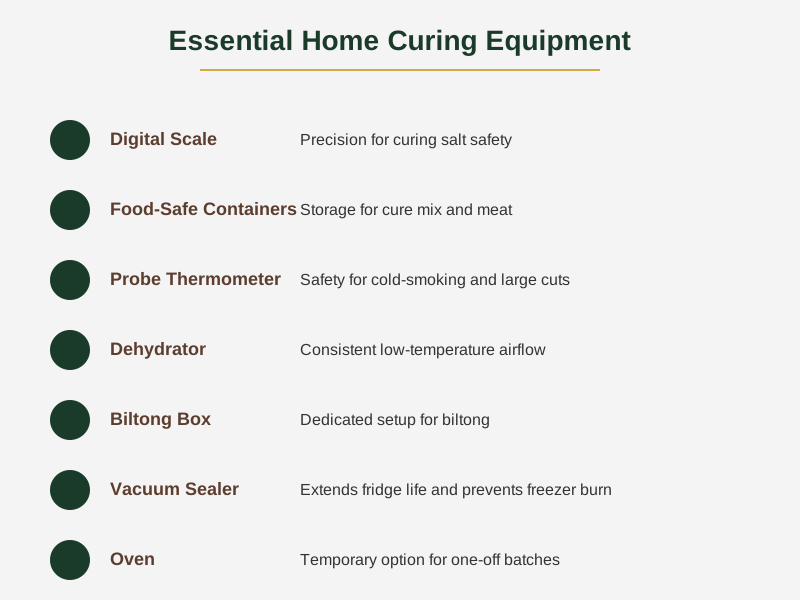
Equipment Overview
| Equipment | Why It Matters | Key Consideration |
|---|---|---|
| Digital Scale (0.1g) | Precision for curing salt safety | Small platform size for large bowls |
| Food-Safe Containers | Storage for cure mix and meat | Glass jars or plastic containers work well |
| Probe Thermometer | Safety for cold-smoking and large cuts | Bluetooth connectivity for monitoring from another room |
| Dehydrator | Consistent low-temperature airflow | Noise levels and durability of the unit |
| Biltong Box | Dedicated setup for biltong | Limited depth may affect hanging long strips |
| Vacuum Sealer | Extends fridge life and prevents freezer burn | Durability and customer service of the machine |
| Oven | Temporary option for one-off batches | Less precise airflow and higher running costs |
Your Upgrade Path
Once you’ve made three successful batches, consider two additions that make sense: a vacuum sealer for batch storage and a better dehydrator if you’re doing larger quantities. The one popular gadget to skip is the meat slicer — it’s expensive and a sharp knife does the job fine for home use.
The equipment list for home curing is shorter than most beginners expect. A 0.1g scale, food-safe containers, a probe thermometer, and — once you’re committed — a dehydrator. That’s the core of it.
What matters more than any gear is the discipline to weigh accurately, follow cure times, and check temperatures. The equipment does the work. You do the thinking.
If you’re ready to start, grab our free checklist — it covers everything you need to have in place before your first cure. Download the Free Curing Starter Checklist and start planning your first batch with confidence.
Related Guides
For a complete overview, see our Home Curing Basics & Safety for UK Beginners .
Sources & Further Reading
As an Amazon Associate we earn from qualifying purchases. The kit linked above is gear we think is worth a look.
Note: General guidance only. Always verify details with a qualified professional or official source.