Home Curing Basics & Safety for UK Beginners
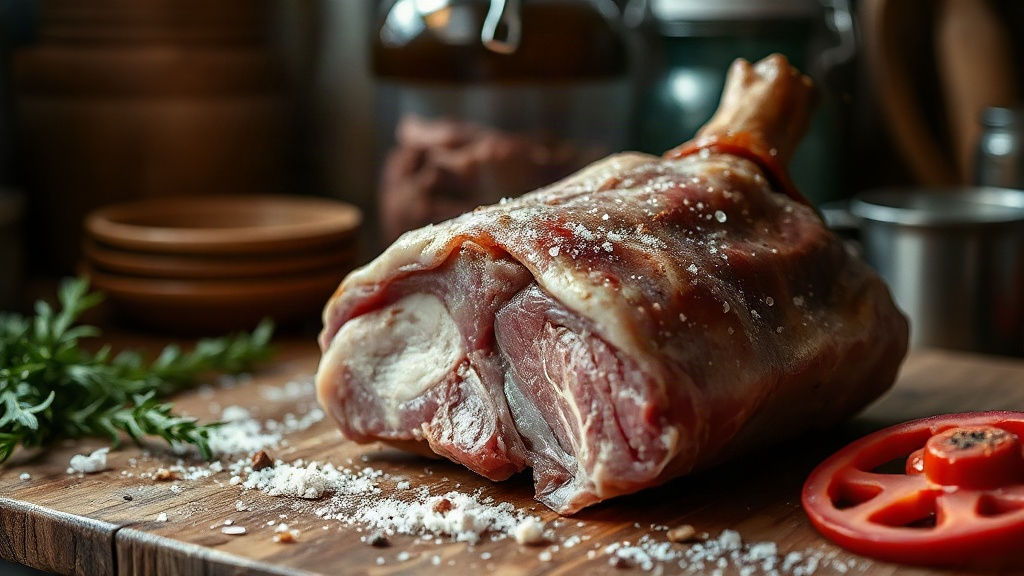
A pork belly and a tub of table salt are not a bacon cure. The pages that turn up for a first home cure hand you a percentage, a thickness, and a few days in the fridge. The Food Standards Agency has not published a home-cure recipe. This page will not invent one.
As an Amazon Associate we earn from qualifying purchases. Some links on this page are affiliate links, which means we may earn a small commission if you make a purchase.
A moist cure in a sealed bag is a different job from a dried snack, and a cold kitchen finishes neither of them. Non-proteolytic Clostridium botulinum grows without oxygen. The FSA’s vacuum-pack question-and-answer says that organism is able to grow and produce toxin at 3°C and above, and that storage below 3°C is what sits outside that guidance. Fresh beef, lamb or pork in a vacuum bag can fall outside it. The same meat mixed with curing salts, herbs or spices does not. Bacon and gammon are not let off because they already contain salt and nitrite. A food business that wants a shelf life longer than 10 days, stored above 3°C, still needs controlling factors in place. That 10 days is not a fridge life for your bacon. The salt figure in the same answer is a level in the water of the food, measured by the business, so it is not printed here. Chill food below 5°C and you slow ordinary bacteria. A fridge doing that job can still be warmer than 3°C. Cold is not the cure.
The dose you are allowed to copy is the one on the pack in your hand. For the curing salt this site links, Surfy’s Prague Powder #1, 500g, colouring-free (paid link), the listing sold by Surfy’s Home Curing Supplies says 2.5g per kg for a dry cure, or 7.5g per litre for a brine, weighed accurately, and only for meat you will cook afterwards, such as bacon, ham and a fresh sausage. That is the curing salt. It is not the table salt, not the sugar, and not a number of days. A different brand’s pack is a different instruction. Read that pack. Do not borrow Surfy’s figure for it.
What a UK kitchen actually has to decide
ProQ’s own bacon page sends you to their calculator or a pre-mixed cure, and it labels the salt and sugar balance as their opinion. Use their calculator if you are using their cure. Do not lift that opinion onto a different powder, and do not treat it as the FSA’s. A British flat in January is not the cool dry room those other methods assume. Copying the room does not make the meat safe.
So. Three jobs, and they do not share a recipe.
Bacon, ham and any other cure that will sit wet in a bag or a box needs a nitrite curing salt at the dose on that pack, weighed, then a proper cook. Table salt does not do the nitrite’s job. A finished vegetable ferment gets its protection from acid, which is the point of Fermentation Safety for Beginners: Avoiding Spoilage . Meat in a bag does not make that acid. Vegetable fermenting is a different craft. Do not borrow its “wait and taste” habit.
Biltong and jerky are the dried snacks. Pink Curing Salt Explained already draws the line this page will not blur: Pink Salt #1 for the moist cures, Prague Powder #2 for the long air-dried whole muscles, and a nitrite-free cure only for biltong and jerky that you eat soon and keep cold. Surfy’s directions, on the listing above, point the other way: that powder is for meat you will cook. Do not use the marketing line on the same page, which mentions jerky, to overrule the directions.
Anything you want to sell, or turn into a ham business from the kitchen, is not a hobby batch. KFMA’s home-produced food page says meat products are high risk because they support harmful bacteria and are often sold ready to eat, names hams among the foods that need premises approval, and says a domestic kitchen can be very hard to get approved. A recipe that is fine eaten straight away does not, on that page, become a shelf life you can print on a pack. Talk to environmental health before you sell anything. This guide is for your own kitchen.
The pack, the scale, and the numbers this page will not give you
There is no nitrite percentage on this page, and no moisture comparison between UK and US pork. The FSA’s scientific committee treats added nitrite as one business control among others, and a limited one: it depends on the rest of the food, and it fades in storage. Surfy’s listing does not state a powder strength. A reseller page does. They do not agree, so this page will not invent the chemistry, or a salt percentage to “correct” a British belly.
Weigh the meat. Weigh the curing salt at the pack’s rate. If the scale can show ounces, look at the unit before the powder goes on. The Etekcity EK9000 (paid link) listing title states 0.1g. Increments are 0.1g, the minimum it claims to measure is 0.3g, and capacity is 5kg. A pinch below that minimum will not appear. It also switches into ounces, which is how a cure gets wrecked by a unit you did not mean to press. Tare the bowl first. The method is in How to Weigh Curing Ingredients Accurately . Going light because you are nervous of salt is the mistake that matters. Common Home Curing Mistakes Beginners Make UK has the direction right: an under-dosed cure is the dangerous one, not a heavy hand with ordinary salt. If the pack is silent, do not invent the gap.
The FSA cooking page calls 8°C to 63°C the Danger Zone, the band where bacteria may grow. That line sits in its leftovers section. Use it for one kitchen habit: do not leave the belly on the counter while you hunt for a recipe. Mix, and get it back into the fridge. That is not a drying temperature, and it is not permission to dry meat just outside that band.
Cuts, without a method
Belly is the bacon cut. Loin is back bacon. Lean beef is the biltong and jerky conversation, and those guides own the cut, the thickness and the drying. Buy a whole piece that has not been brined, marinated or pumped with water. If the label says brined, or with added water, you are not starting from fresh meat, and a standard pack dose on top of an unknown brine is how a cure goes wrong. The bacon guide is the place for that check. This page will not tell you to trim to a thickness, hang strips, or judge doneness by a squeeze. A firm feel is not a safety test.
What to buy, and what to leave until you know the job
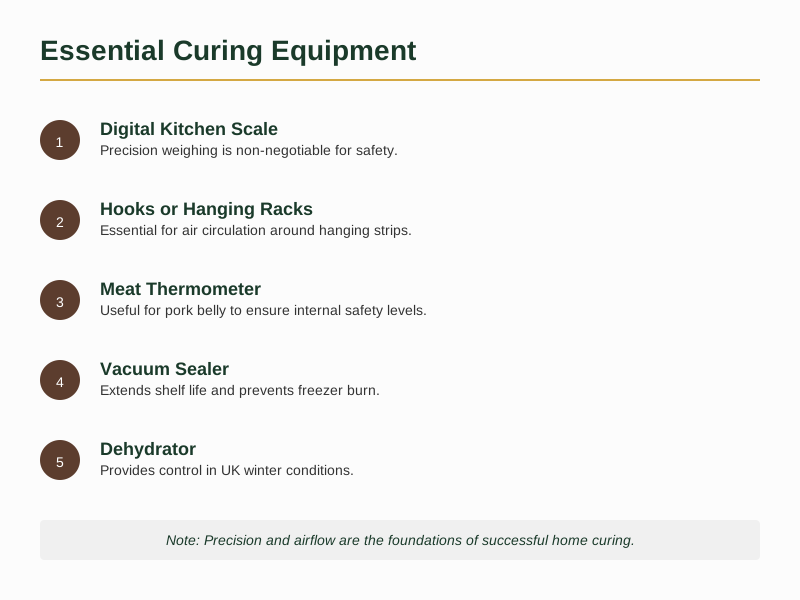
Essential UK Home Curing Equipment for Beginners has the order right. The scale comes first. A biltong box is worth it only if biltong is the thing you already know you will make. For everyone else the first machine, if you buy a machine at all, is a dehydrator, because it is not a one-job box. Do not start by hanging meat in the coolest room to “see what happens”. That is how a wet centre sits in still air.
Digital kitchen scale. The Etekcity EK9000 Food Kitchen Scale (paid link) is the 0.1g listing for the curing-salt dose. The review summary on that page is mixed on durability, with reports of units failing within a few months. The Salter 1036 Digital Kitchen Scale (paid link) is the scale for the joint, not for the curing salt.
Meat thermometer. You need one once the pork is cooked, because colour is a poor proof either way. The ThermoPro TempPro TP25H2 Wireless Bluetooth Meat Thermometer (paid link) is the leave-in, with dual probes and an app. The ThermoPro TP516 Instant Read Meat Thermometer (paid link) is the spot check. It is not a probe you leave in the meat.
Humidity controller. Only for a box you are already running. The Inkbird IHC-200 Dual Relay Humidity Controller (paid link) switches a humidifier and a dehumidifier. It is a controller, not a hygrometer you read. Read the manual before you wire it in.
Vacuum sealer. Useful after a cure is finished, and not a reason to give the bag a long life. The FSA page above is written for businesses who vacuum-pack chilled food. A home sealer does not put you outside it. The FoodSaver VS3190 Multi-Use Preservation System (paid link) is the silver unit with a handheld sealer, a roll and bags. The Bonsenkitchen Vacuum Sealer (paid link) is the compact one.
A dehydrator holds a temperature and an airflow you chose. That is control. It is not, by itself, a safe drying recipe, and this page will not name a drying temperature. The Excalibur 5 Tray Stackable Food Dehydrator (paid link) is the larger stackable unit. Durability complaints show up often enough to mention. The Aigostar 5 Tier Food Dehydrator (paid link) is the other stackable machine. Whatever range is printed on its dial is the machine’s range, not a temperature I am giving you for meat.
A biltong drying box does one job. The Biltong Banter Box Biltong Maker DIY Kit (paid link) is a kit you assemble, not a finished box. The biltbox Home Biltong Maker Box (paid link) is wood, sold with a fan and no assembly.
See biltbox Home Biltong Maker Box on Amazon → (paid link)
Cook the pork. Do not trust a squeeze, a smell, or a colour
📺 Watch: How To Make Bacon From Scratch At Home…‘English’ AND ‘American Style’
The film is a bacon demonstration. If a weight appears on screen, it is not your pack. Use the dose on the tub you bought.
When the cure is finished, pork still has to be cooked through. The FSA’s cooking guidance says pork can carry bacteria all the way through, unlike a steak. The middle should reach 70°C for 2 minutes. The same page also lists 60°C for 45 minutes, 65°C for 10 minutes, 75°C for 30 seconds and 80°C for 6 seconds. Those are cooking combinations, not cure times and not drying times. Use a clean thermometer and keep the tip off the bone. If you have no thermometer, the FSA’s visual cues are clear juices, no pink fleshy meat, and steam from the middle. The hepatitis E page names bacon in particular: steaming hot all the way through, no pink in the thickest part, juices clear. Do not invent an exception because a cure can leave meat looking pink.
When it looks wrong
NHS guidance on botulism is the medical page, and botulism is rare in the UK. It is still life-threatening. Foodborne botulism comes from food that was not cooked or stored properly. Call 999 if you or a child may have symptoms: blurred or double vision, drooping eyelids, difficulty swallowing or speaking, weak face muscles, a floppy child. Do not drive yourself to A&E.
The NHS also says do not eat food that smells bad. A bad smell means it goes in the bin. A normal smell is not a clearance. This page will not give you a smell test, a squeeze test, or a mould-colour test that passes a cure. White mould is not “fine, wipe it and carry on”. If you see mould, do not eat the meat. If you are unsure, do not eat it.
Under-dosing is the failure to fear, and you will not see it. That is why the scale and the pack exist. Over-dried, brittle meat is a thickness and airflow problem for the drying guides, not a sign you should have cooked it less.
There is no fridge life and no freezer life on this page. Vacuum sealing removes oxygen. For this organism, removing oxygen is the problem the FSA wrote the business guidance about, not a preservation trick that lets you forget the date. Label the bag with the day you sealed it, keep it cold, cook pork through, and when in doubt throw it out.
Now you know what to look for — Download the Free Fermentation Starter Checklist to audit the kitchen before you buy a box.
Slicing, and the tub itself
Keep the curing salt in the labelled pack. Do not tip it into an unmarked jar. The powder looks pale because the listing is colouring-free. That pale look is the product.
See Surfy’s Prague Powder #1, 500g, colouring-free on Amazon → (paid link)
Meat slicer: The FOHERE Electric Meat Slicer (paid link) has two removable blades, one smooth and one serrated. The Progress Electric Food Slicer (paid link) is the smaller one, with a serrated blade.
Check Progress Electric Food Slicer price → (paid link)
Jerky gun: The stainless steel jerky gun kit (paid link) is the listing. Owners use it for uniform strips. The spring is the part that wears.
Check Jerky Gun Kit price → (paid link)
Where each guide picks up
- Essential UK Home Curing Equipment for Beginners — buy the 0.1g scale before anything else. A biltong box is optional. A dehydrator is the better first machine unless biltong is already the only plan.
- Pink Curing Salt Explained — Pink Salt #1 for bacon and ham, Powder #2 for the long air-dried muscles, nitrite-free only for biltong and jerky you will eat soon and keep cold. Himalayan pink salt is a cooking salt.
- How to Weigh Curing Ingredients Accurately — tare the bowl, and check the scale is showing grams before the cure goes on.
- Common Home Curing Mistakes Beginners Make UK — the dangerous direction is going too light because you are scared of salt. Still no percentage on this page.
- Home Curing Basics & Safety for UK Beginners: Questions Answered — the short answers, after you have the rule above.
I’d buy the scale and the curing salt, cook a small belly, and leave the drying box on the shelf until a dried snack is actually the plan. The accomplishment is a batch you can defend, not a tub of pink powder used on guesswork.
Download the Free Fermentation Starter Checklist and work through it before you spend money on a box.
Sources & Further Reading
- FSA: safety and shelf-life of vacuum and modified atmosphere packed chilled foods, additional Q&A (PDF)
- FSA: vacuum packaging (business guidance)
- FSA: cooking your food
- FSA: hepatitis E, including bacon
- NHS: botulism
- KFMA: home-produced food
- Surfy’s Prague Powder #1 listing, ASIN B071X2K1YQ
- Etekcity EK9000 listing, ASIN B0871TQ9NK
- ProQ: the basics of home cured bacon
As an Amazon Associate we earn from qualifying purchases. The products linked above are ones we think are worth a look.
Note: General guidance only. Always verify curing ratios and safety guidelines with a qualified professional or official source.