How Long to Dry Biltong in the UK
As an Amazon Associate we earn from qualifying purchases. This page contains affiliate links — if you buy through them, we earn a small commission at no extra cost to you.
Is your biltong ready? The real test isn’t the calendar—it’s the squeeze. A properly dried stick should feel firm and leathery, offering a little give but never softness. Drying time is simply however long it takes to get there, and in the UK, that answer varies wildly.
The honest answer is that biltong drying time in the UK depends almost entirely on your method, not a universal rule. A dehydrator can deliver safe, consistent biltong in a matter of hours. A biltong box in a spare room could take a week — or fail entirely if the humidity ticks up. The classic “four days” figure comes from South African conditions where ambient air is dry and reliable. The UK’s damp, unpredictable climate doesn’t play by those rules, which is why beginners often end up with a batch that’s either under-dried and risky, or so salty it’s inedible.
What follows is a method-by-method breakdown so you can pick the setup that actually fits your kitchen — not the one that works in a Cape Town garage.
The UK’s Humidity Problem
Biltong is about removing moisture, not just applying heat. The goal is to drop the water activity level to around 0.7–0.75, a threshold supported by an FSA literature review on dried meats, below which harmful bacteria can’t reproduce effectively. That’s a moisture and airflow problem as much as a temperature one.
UK weather is the antagonist here. High humidity slows evaporation dramatically. A rainy week doesn’t just slow drying — it can reverse it, leaving meat damp enough for spoilage organisms to take hold. The same batch that dries well in a dry, warm spell can take far longer when damp weather moves in. There’s no fixed time you can rely on when the variable is the Great British weather.
So what does actually work in a UK kitchen?
Fast and Reliable: The Dehydrator Route
A dehydrator takes the weather out of the equation entirely. A dehydrator is likely to give more even results than a box, which can vary with the season. A flat in London with the heating on in February is a completely different drying environment to a garden shed in August, and the dehydrator handles both without you having to think about it.
📺 Watch: How to make BILTONG in a Food Dehydrator
Set the temperature to around 40°C, slice your meat to roughly 5–10mm, and you’re typically looking at a few hours for thin cuts. The forced-air circulation maintains a consistent temperature and airflow.
The texture is more consistent, too. Because the airflow is even, the outer surface doesn’t dry faster than the interior — you get a uniformly firm result from edge to edge, rather than a crusty exterior with a softer core. That’s the trade-off with ambient drying: the longer exposure can develop more complex flavour, but the inconsistency is real and often disappointing.
On budget: the Aigostar 5 Tier Food Dehydrator (paid link) is 240W, with a 99-hour timer and a 35–70°C range, so the low end covers biltong. It is slower than a larger unit and has no viewing window. If you are drying regularly, the Excalibur 5 Tray Stackable Food Dehydrator (paid link) is the step up. Owners do flag durability on some Excalibur units, so buy somewhere with a real returns window.
See Aigostar 5 Tier Food Dehydrator on Amazon → (paid link)
If you’re weighing whether to invest in a dehydrator, here’s the honest version: for biltong specifically, yes — it’s the one piece of kit that removes the biggest variable (weather) from the process.
Traditional Air-Drying: The Biltong Box
Purists argue that air-dried biltong tastes better — the longer, slower drying at cooler temperatures can develop more complex flavour than a quick dehydrator run. If you’ve got a stable, dry environment and you’re patient, the box method can produce excellent results.
📺 Watch: How to Make Your Own Biltong Dryer | DIY Biltong box | Xman & Co
But “stable, dry environment” is doing a lot of work in that sentence. In the UK, it typically means a heated garage, a dry cellar, or a spare room with the heating running consistently. A damp spare room in a UK winter is not that. In variable conditions drying times can stretch well beyond the usual estimate, and a batch that stays damp is not worth eating.
The Home Biltong Maker Box (paid link) is a compact, beginner-friendly option. The catch: its limited internal depth means longer meat strips may need to hang at an angle or be cut shorter than you’d like.
For the box method to stand a chance, you need a space with a temperature ideally between 10–15°C, humidity below 60%, no direct sunlight, and proper fly-proofing. Miss any of those and you’re introducing variables that can ruin a batch. It’s worth noting that using a regular kitchen cupboard is rarely successful in the UK, as kitchens are usually too humid for consistent results. The moisture in the air fights against evaporation, meaning your batch dries unevenly or slowly.
Topside and silverside are common choices of meat, valued for their leanness and good flavour. Both are widely available in UK supermarkets and butchers. Ask your butcher to slice it for you at roughly 5–10mm if you don’t have a good slicer at home.
Methods to Approach with Caution
Many UK ovens don’t go low enough, often starting at 60°C or above, which can cook the meat rather than drying it gently. The hot air fan in a conventional oven can make this worse, blasting the surface. The result often has a jerky-like texture rather than the characteristic give of biltong.
Using a shed is a seasonal gamble. Humidity swings, unexpected cold snaps, and insects present significant hurdles. It’s not the method to start with if you’re new to this. If you’re determined to use an oven, you’d need one that can hold 50°C reliably with the door cracked open for airflow — and even then, it’s a compromise.
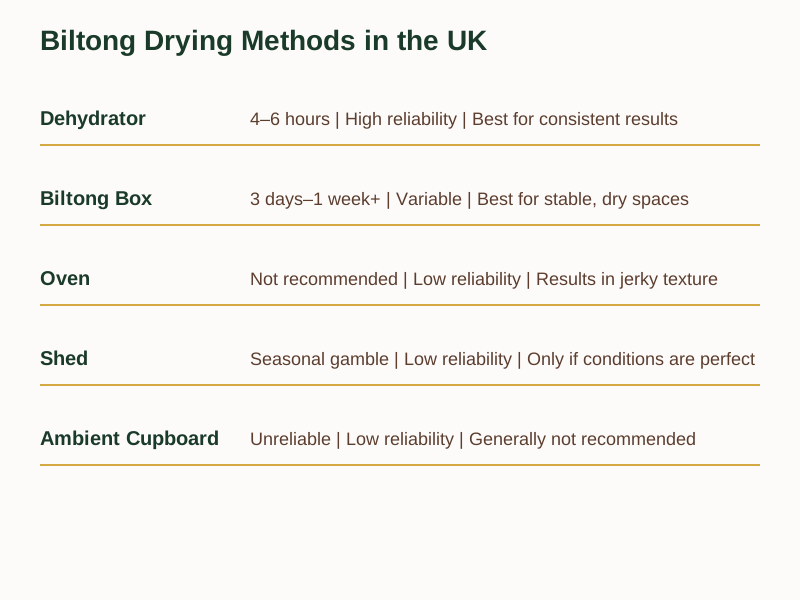
Drying Method Comparison
| Method | Typical Timeframe | Reliability | Best For |
|---|---|---|---|
| Dehydrator | A few hours | High | Beginners and consistent results |
| Biltong Box | 3 days – 1 week+ | Variable | Those with stable, dry spaces |
| Oven | Varies, often unsuitable | Low | Often produces a jerky-like texture |
| Shed | Seasonal gamble | Low | Only if conditions are perfect |
| Ambient Cupboard | Unreliable | Low | Generally not recommended in the UK |
The Final Decision
The short version: a dehydrator set around 40°C delivers safe, consistent biltong in a predictable timeframe, regardless of the weather. That’s the method we’d suggest for anyone starting out in the UK — it removes the biggest variable and lets you focus on getting the cure right.
The biltong box is a genuine option if you have a reliably dry space and value that slower-developed flavour — but be realistic about your environment. The oven is generally a compromise, and the shed is a seasonal punt.
Safe biltong should be firm to the touch, with no soft or tacky patches. The technical benchmark, as noted in the FSA literature review, is a water activity of 0.7–0.75. If you don’t have specialised gear, the firm texture test is a common home check, though less precise. If you’ve used a wet cure (vinegar and spices), a quick rinse before hanging is standard practice to remove excess surface salt. Skipping this step can result in an overly salty final product.
The most critical point is patience. An extra day hanging costs nothing if it ensures the batch is properly dried, while cutting it early risks the whole endeavour. Now you know what to expect — so pick your method, get your cure sorted, and have a go. If you want a step-by-step rundown of the full process from cut to cured, download the free Fermentation Starter Checklist — it’s got everything you need to get started confidently.
Related Guides
For a complete overview, see our How to Make Biltong at Home in the UK .
Sources & Further Reading
As an Amazon Associate we earn from qualifying purchases. The products linked above are ones we think are worth a look.
Note: General guidance only, verify details with a qualified professional or official source.