How to Make Biltong at Home in the UK
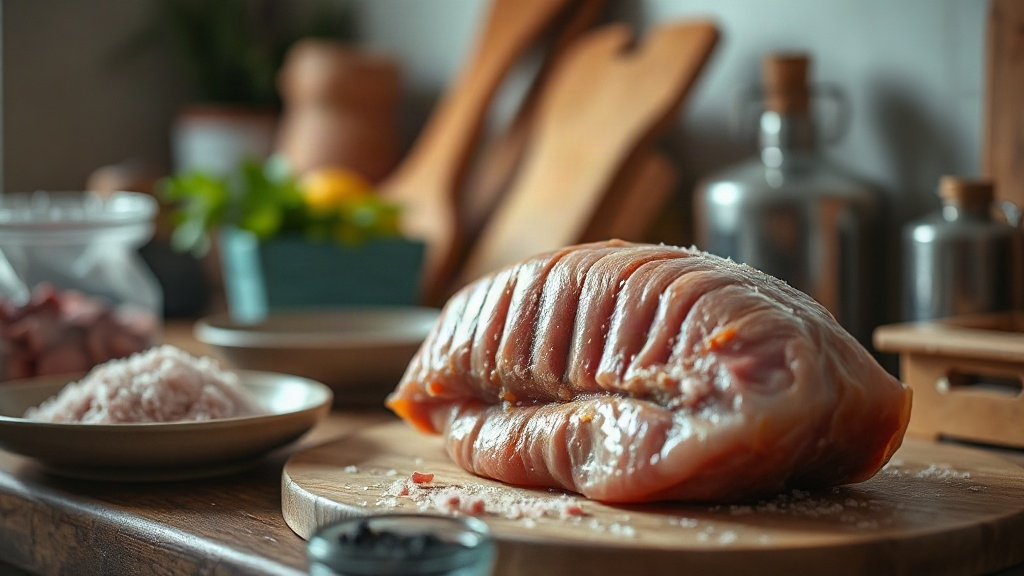
A cool British room is where people hang biltong because that is how the story goes. It is the wrong room.
As an Amazon Associate we earn from qualifying purchases. This page contains affiliate links — if you buy through them, we earn a small commission at no extra cost to you.
Do not air-dry biltong in unheated UK air. A 2010 draft literature review prepared for the Food Standards Agency says solar drying and unheated air are not suitable for the UK climate, and that the colder, moister air here, compared with South Africa, is not conducive to making biltong in ambient conditions. Ambient drying, the review says, is unsuitable in the UK. The drying air should be heated to around 35°C, depending on the conditions around it. A lower air temperature means a longer dry, and the review says that slower dry increases the microbiological hazard. That is the opposite of “turn it down to be gentle”.
The same review says a water activity of 0.7 to 0.75 is the advisable end point, and that weight loss is the indicator of it. You cannot measure water activity in a kitchen. A squeeze, a dark colour, or “it feels like the web of my hand” is not that measurement. One table in the review associates 35°C air with a stable product in around 6 days. The next paragraphs take the calendar away: UK summer air at 18°C and 65% relative humidity, heated to 35°C, becomes much drier and the review says the product would dry in less than 6 days; winter air at 4°C and 85% relative humidity, heated to 35°C, can over-dry. Those are the review’s weather examples, not a setting for your box. Do not copy 6 days onto a dial.
The review is a draft written for the Agency in March 2010 by Campden BRI. It is not a home recipe and it is not a new regulation. It is the page that actually looked at UK air. Read it: literature review on biltong and similar dried meats (PDF) .
The cut, before any spice
Best Beef Cuts for Biltong in the UK is the buying decision. Topside is the first cut: lean, straight grain, easy to trim. Silverside is the one a maker will still name. Biltong St Marcus recommends silverside, and then tells you to hang strips in a cool ventilated spot for somewhere between 3 and 15 days and to judge them with a finger squeeze. That range is a taste preference. The cuts guide is stricter for a first batch: silverside has a connective seam through it, so the slices fight you. Sirloin is the wrong spend. The fat that makes it a steak is the fat that goes stale on a drying rack. Trim visible fat either way. The review treats drying as a process for sound meat, not a way to use up trimmings.
📺 Watch: Biltong for Beginners (Easy to Follow Recipe)
The film is a demonstration. A thickness, a salt spoon or a temperature on screen is not a figure from the review above, and it is not an instruction from this page.
Vinegar is the acid. The tub of curing salt is a different product
The Perfect Biltong Vinegar and Spice Mix splits the job the way the review does. Vinegar is the acidic part of the marinade. Coriander and black pepper are the flavour. This page will not give you a millilitre of vinegar per 100g of beef, and it will not claim that splash drops the surface to a pH you can check at home. The review’s handling line is the cold: acidic marinades should be used at 0 to 4°C. That is the fridge, not the counter. It is not a number of hours.
Surfy’s Prague Powder #1, 500g, colouring-free (paid link) is a nitrite curing salt. The listing’s own directions limit it to meat you will cook afterwards, such as bacon, ham and a fresh sausage. Biltong is not that cook. Adding the powder “to be safer”, or adding it at a percentage copied from somewhere else, is not what the listing says. Pink Curing Salt Explained already draws the line: nitrite-free is the biltong path, and only if you eat it soon and keep it cold. The powder looks pale because that listing is colouring-free. Pale is the product. It is still the wrong product for an uncooked dry snack.
Weigh whatever the vinegar guide tells you to weigh. A spoon of salt is not a dose. There is no salt percentage on this page. Surveys of finished commercial biltong, inside that same review, measured salt already in the meat. That is not a weight to add to raw beef.
Do not borrow a jerky setting either. The review separates the two snacks in one line: biltong is marinated and then dried in warm air, around that 35°C; jerky is marinated, cooked, and then dried hotter, above around 60°C. A jerky heat on biltong is a different product. A biltong heat on jerky is the one the review says is too cool for that cook-then-dry path. The jerky guides on this site own that path. This page will not hand you either dial as a timer.
The machine is forced warm air, not the spare room
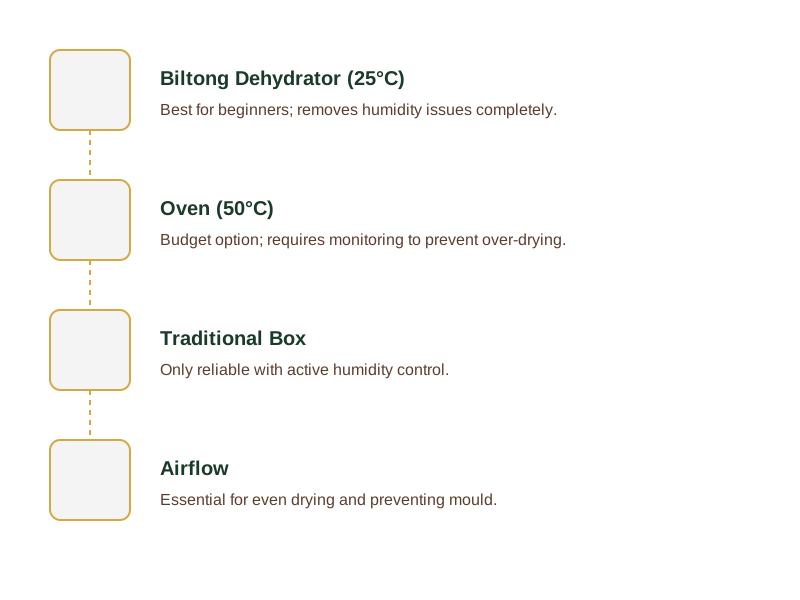
Biltong Drying Box vs Dehydrator vs Oven UK picks a dehydrator over a box for a British kitchen. The review agrees with the direction, in plainer words: a batch dryer with a fan — forced convection — is the appropriate machine, and unheated air is unsuitable here. A wooden box with a fan is only as good as the air it is pulling. If that air is the cool damp room, you are back in the method the review rejects. An oven, the review notes, is what small producers reach for, and it gives them little humidity control beyond opening the door. This page will not tell you to prop a door with a spoon or to chase an internal meat temperature. Those are not in the review, and a door left ajar is not a humidity control.
How Long to Dry Biltong in the UK is where the calendar argument lives. Use it for the texture you want. Do not use a firm centre as proof the water activity is 0.7 to 0.75. The review wants that end point. It does not give you a finger test for it.
Mould, smell, and the bag
If you see mould, do not eat the meat. Do not wipe a white dusting and carry on. NHS guidance on botulism says do not eat food that smells bad. A normal smell is not a clearance either. Botulism from food that was not cooked or stored properly is rare in the UK and still a reason to call 999 if vision, swallowing or the face goes wrong. Do not drive yourself.
There is no fridge life and no “few weeks once opened” on this page. Vacuum sealing takes oxygen away. That is useful against ordinary spoilage and useless as a date. The Bonsenkitchen Vacuum Sealer (paid link) is the compact machine. Keep what you will not eat soon in the cold, and throw it out when you are unsure.
See Bonsenkitchen Vacuum Sealer on Amazon → (paid link)
Where to go from here
I’d buy topside, keep the vinegar step in the fridge, and dry in a machine that can hold warm moving air. I would not hang the first batch in the spare room to see what a British week does to it.
- Best Beef Cuts for Biltong in the UK — topside first. Silverside has the seam. Sirloin is the steak.
- The Perfect Biltong Vinegar and Spice Mix — vinegar is the acid, coriander and pepper are the flavour. The quantity stays on that page.
- Biltong Drying Box vs Dehydrator vs Oven UK — a dehydrator over a box that is only as dry as the room. The oven is the compromise.
- How Long to Dry Biltong in the UK — texture and timing. A squeeze there is not a water-activity test here.
- How to Make Biltong at Home in the UK: Questions Answered — the short answers, after the rule above.
Now you know what to look for — Download the Free Fermentation Starter Checklist before the first batch.
Download the Free Fermentation Starter Checklist and work through it when the beef is still in the shop, not when the strips are already hung.
Sources & Further Reading
- Campden BRI draft literature review for the Food Standards Agency, biltong and similar dried meats, March 2010 (PDF)
- Biltong St Marcus: how to make biltong
- NHS: botulism
- Surfy’s Prague Powder #1 listing
As an Amazon Associate we earn from qualifying purchases. The products linked above are ones we think are worth a look.
Note: General guidance only. Always verify details with a qualified professional or official source.