How to Weigh Curing Ingredients Accurately
As an Amazon Associate we earn from qualifying purchases. This page contains affiliate links — if you buy through them, we earn a small commission at no extra cost to you.
The difference between a stronger and a weaker salt cure on a kilo of pork belly is only a few grams—a gap that looks identical in a teaspoon and feels the same to the touch. That invisible margin decides whether your bacon cures properly or stays unsafe. This guide shows how to measure what your eyes can’t see.
Curing salt is dosed in just a few grams per kilo, so a slip of one gram can swing the amount you meant to add by a third or more. That single gram is the difference between a successful cure and a wasted joint.
Why spoons and cups fail for curing ingredients
Volume measurements like teaspoons are inherently inconsistent. A heaped teaspoon of salt holds roughly twice as much as a level one. Humidity, how recently you opened the container, whether your salt has clumped—all these factors change what actually lands in your bowl. Across different days, “one teaspoon” is not a fixed amount but a guess.
📺 Watch: How to Cure Salmon at Home and Make Gravlax
The UK market adds another complication. Most kitchen scales here switch between grams and ounces. If your scale gets nudged onto the ounce setting accidentally—easy on compact models—and you read the display as grams, you’re adding roughly 28 times too much. A heavy hand with cure salt on a small joint doesn’t just make it unpalatably salty; with curing salt it raises genuine food safety concerns.
The solution isn’t a better recipe. It’s switching to weight measurements and understanding how your specific scale works.
The weighing protocol that prevents errors
Follow these three steps before every cure batch. They’re simple but prevent the most common mistakes behind failed cures.
Step 1: Tare with your bowl already in place
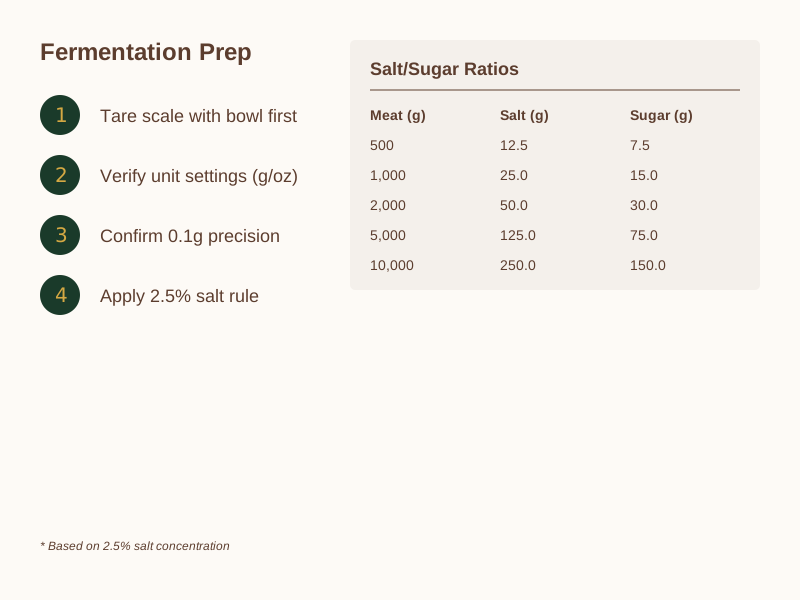
Place your mixing bowl on the scale and press tare. The display reads zero. Add your meat and note the weight—no arithmetic needed. Then add cure ingredients directly into the same bowl. The display updates to show cumulative weight. Stop when you hit your target salt or cure weight. Weigh every ingredient accurately before mixing.
Step 2: Verify the unit setting every time
Before weighing, check the display. Does it say g or oz?
On most UK digital kitchen scales, the unit toggle is a small button easily pressed accidentally when wiping the scale or reaching across the worktop. Even experienced home cooks can be caught out by this: one moment the scale is in grams, the next it isn’t, and the cure is dosed in ounces unnoticed.
If your recipe specifies a number of grams but your scale is reading ounces, you’ve added roughly 28 times the intended amount. That batch cannot be salvaged.
The conversion is 1oz = 28.35g. Keep this number handy by your scale to prevent this class of error.
Step 3: Use a scale that reads fractions of a gram
For pink curing salt (sold as Prague Powder #1 or Cure #1 — Surfy’s 500g colouring-free pack (paid link) is one), recipes use only a few grams per kilo of meat, so follow the dose on your packet. If your scale only reads to the nearest gram, you can’t tell a two-gram dose from a three-gram one. That variation is unnecessary and avoidable.
A scale that reads to a fraction of a gram is inexpensive, and for regular work with pink curing salt it isn’t a luxury but a basic requirement. Check the listing for the stated resolution before you buy, as not every model in a range carries it.
Calculating salt amounts by percentage
With your meat weight confirmed and scale set correctly, calculating the cure becomes straightforward arithmetic. Many bacon recipes use roughly 2–3% salt by meat weight. Some add a little sugar for flavour balance, though a salt-only cure works perfectly well.
The formula is simple (shown here at a mid-range 2.5%):
Salt weight (g) = Meat weight (g) × 0.025
For 500g of pork belly: 500 × 0.025 = 12.5g salt
For 1kg: 1,000 × 0.025 = 25g salt
If including sugar, work out its share the same way from your recipe’s percentage.
Applying cure as a percentage of meat weight removes batch size variability. A cure for a whole ham uses the same percentage as for a small belly—the ratio holds regardless of scale. This approach delivers consistent results.
Selecting an appropriate weighing scale
Two features matter most for curing: fine resolution (fractions of a gram) and a reliable tare function. Everything else is secondary.
The Etekcity EK9000 Food Kitchen Scale (paid link) is the listing whose title states 0.1g precision, which is what a curing-salt dose needs. The platform is the larger of the two, so a bowl sits more steadily. Stock was not confirmed on this check, so look at the page before you count on it. Some users find the display hides behind the bowl.
See Etekcity EK9000 Food Kitchen Scale on Amazon → (paid link)
The Salter 1036 Digital Kitchen Scale (paid link) is a 5kg scale with a tare button and a stainless platform. Its listing does not state a 0.1g resolution, so use it for the meat and the bulk salt, not for the curing-salt dose. The platform is small, and on a polished worktop it can slide — a damp cloth underneath helps.
See Salter 1036 Digital Kitchen Scale on Amazon → (paid link)
Weigh the curing salt on the scale whose listing states 0.1g. Use the 5kg scale for the joint.
Now you understand what to weigh, which units to verify, and how much salt to use. Before starting your first batch, grab our free curing checklist —it guides you through the entire process from weighing to storage.
Quick reference table for common weights
| Meat Weight (g) | Salt Weight (g) | Sugar Weight (g) |
|---|---|---|
| 500 | 12.5 | 7.5 |
| 1,000 | 25.0 | 15.0 |
| 2,000 | 50.0 | 30.0 |
| 5,000 | 125.0 | 75.0 |
| 10,000 | 250.0 | 150.0 |
Common questions about weighing for curing
Can I use a scale that measures in pounds and ounces?
Yes, but convert before starting. One pound equals 453.6g and one ounce equals 28.35g. Safer still: switch the display to grams and work entirely in metric—this eliminates conversion steps and unit-mixing risks.
Should I calibrate my scale before every cure?
Not necessarily. Calibration matters most after dropping, long storage, or obviously wrong readings. For home use, a quick check—weighing a known object such as a calibration weight or a bottle of water—confirms consistent reading. Consistency matters more than laboratory precision.
What if my scale only measures to 1g?
You can still weigh the salt, but adjust batch sizes. With whole grams as your smallest increment, cure larger pieces of meat so the amounts you weigh are comfortably more than a few grams. A small belly needs around a dozen grams of salt, which is manageable. A tiny piece needing only a couple of grams pushes the limits of such scales, and the curing salt dose is smaller still, so a fine-reading scale is the answer.
Related guides
For complete background, see our Home Curing Basics & Safety for UK Beginners .
References
Calibrate your scale monthly against a known weight and remember to tare every container—these two habits keep the article’s maths honest. The wider safety picture is in Home Curing Basics & Safety for UK Beginners .
As an Amazon Associate we earn from qualifying purchases. The products linked above are ones we think are worth a look.
Note: This article provides general guidance. Always verify specific curing ratios and safety procedures with qualified professionals or official sources.